
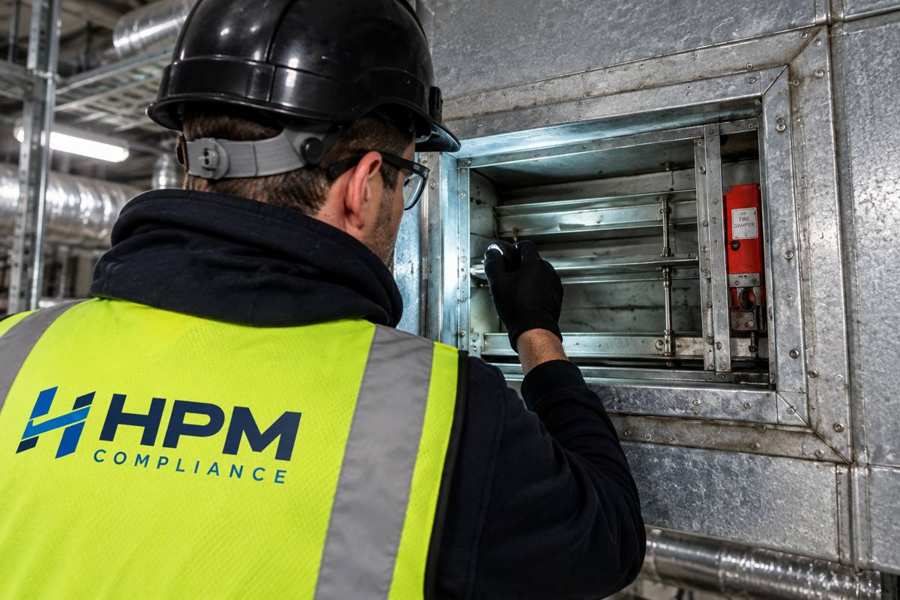
Fire dampers are installed within ventilation systems where ductwork passes through fire-resisting construction. Their purpose is to close when required and help preserve the fire separation between parts of a building. Because they can remain hidden above ceilings, inside risers or within ductwork for long periods, their condition and operation need to be checked as part of a suitable maintenance programme.
So, how often should fire dampers be tested?
There is no single statutory annual interval that applies to every fire damper in every building. BS 9999:2017 states that all fire dampers should be tested by a competent person on completion of installation and at regular intervals not exceeding two years, with spring-operated fire dampers tested annually. In practice, many organisations and specifications adopt annual testing across their fire damper estate, particularly where this reflects the building fire strategy, manufacturer information, site conditions or client requirements.
What does fire-safety law require?
In England and Wales, the Regulatory Reform (Fire Safety) Order 2005 places duties on the Responsible Person to ensure that relevant fire precautions are subject to a suitable system of maintenance and are maintained in efficient working order and good repair where necessary to safeguard people.
Government guidance explains that regular inspection, testing and servicing are how fire-safety measures are kept in an efficient state, and specifically identifies smoke-control systems, including fire dampers, among systems that may need inspection, testing and servicing.
Why might some dampers need more frequent attention?
An annual programme may not always be enough. More frequent inspection can be sensible where the installation is exposed to conditions that may affect reliable operation, or where previous testing has identified recurring problems.
- Grease, dust or other contamination is present.
- The damper is installed in a particularly demanding environment.
- Previous inspections have identified failures or restricted movement.
- The manufacturer specifies a shorter interval.
- The site's fire strategy or risk assessment requires it.
- Access problems mean assets have historically been missed or incompletely tested.
What should happen during a fire damper inspection?
The exact procedure depends on the damper type and installation, but a competent inspection normally starts with correctly identifying the asset and confirming that suitable safe access is available. The accessible damper and surrounding installation are visually checked and the damper is functionally operated where appropriate to its type.
The result should be recorded clearly. Where an asset cannot be safely accessed or fully tested, the limitation should be recorded rather than the damper being presented as successfully inspected.
Useful records can include
- Asset number or unique reference
- Damper location
- Date of inspection and test
- Damper type where known
- Functional test result
- Condition observations
- Photographic evidence
- Access restrictions or limitations
- Defects and recommended follow-up action
What if a fire damper fails?
A failed test should result in a clear record of the defect and appropriate follow-up. The next action depends on what caused the failure. It may involve cleaning, adjustment, improved access, further specialist investigation, repair, replacement or work to the surrounding installation.
The important point is that a failure should not simply disappear into a report. The Responsible Person or facilities team needs enough information to understand what requires attention and to track the remedial action through to completion.
Who should carry out fire damper testing?
Government fire-safety guidance states that people appointed to carry out testing and maintenance should be competent to do so. Competence is about having the appropriate knowledge, training, skills and experience for the work being undertaken, including understanding the relevant damper type, safe access requirements and the limits of the inspection.
Fire damper testing in South Yorkshire
HPM Compliance provides commercial fire damper inspection and testing across South Yorkshire, including Rotherham, Sheffield, Doncaster, Barnsley, Mexborough and surrounding areas. Our service is built around clear asset identification, functional checks where appropriate, photographic evidence and usable reporting for facilities and property-management records.
For the full service scope, see our Fire Damper Testing service page.
Need to arrange fire damper testing?
Tell us the site location, approximate number of dampers and whether you have an existing asset list, drawings or previous report. We can discuss the requirement and provide a clear quotation.
Request a Fire Damper QuoteThis guide provides general information only. It does not replace a site-specific fire risk assessment, fire strategy, applicable legislation, manufacturer instructions, relevant standards or advice from a competent fire-safety professional. Standards and guidance can be revised, so current requirements should be checked when planning work.